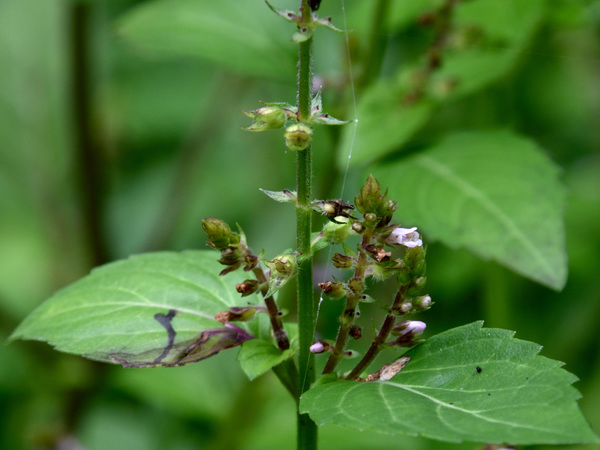
Japanese name: イヌコウジュ(犬香需) Scientific name:Mosla scabra
[Overview]
An annual 20–70 cm tall, found at woodland edges and roadsides in hills and fields.
The stem is erect, much branched, and square in cross section.
The stem is often tinged with reddish purple.
The stem is densely covered with downward-curved hairs.
The leaves are simple and opposite, narrowly ovate to ovate, 2–4 cm long and 1–2.5 cm wide, with fine hairs on the upper surface and short hairs on the veins of the lower surface.
The leaf margins have 6–13 pairs of low teeth.
The petiole is 1–2 cm long.
The flowers are borne in pairs at each node and form a spike.
The axis of the inflorescence is densely covered with spreading hairs.
The flowers are pale red and two-lipped, with the upper lip 3-lobed and the lower lip 2-lobed.
The calyx is sparsely hairy and 5-lobed, and the tip of the upper calyx tooth is sharply pointed.
The bracts are shorter than the pedicels and linear-lanceolate.
The fruit is a schizocarp with a reticulate pattern on the surface.
[Uses]
The whole plant is used as a bath additive.