
Plant Encyclopedia

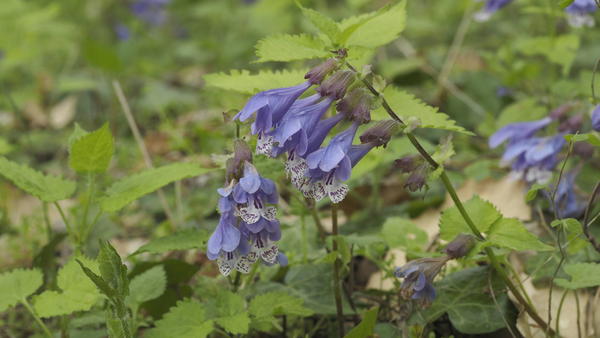
Meehania urticifolia ("Rashomonkazura")
Japanese name: ラショウモンカズラ (羅生門葛)
Scientific name: Meehania urticifolia
[Overview]
A perennial 20–30 cm tall, often growing in colonies along mountain streams and brooks.
The whole plant is fragrant.
The stem creeps for a long distance along the ground, rooting at the nodes, and the tip stands erect.
Leaves are simple and opposite, triangular-ovate, 2–5 cm long and 2–3.5 cm wide, with coarse teeth.
The petiole is 2–3 cm.
The flower stalk is erect and 20–30 cm tall, and several flowers bloom facing one direction on the upper part of the stem.
The flowers are purple, labiate, and 4–5 cm long; the upper lip is 2-lobed and the lower lip is 3-lobed, with a large central lobe that curves downward and is shallowly 2-lobed, with dark purple spots and long white hairs.
The fruit is a schizocarp with sparse hairs.
[Cultivation]
Propagate from seed, by division, or by shoot cuttings.
It prefers well-drained soil.
From autumn to spring, place it in a sunny spot; in summer, place it in airy partial shade.
Water thoroughly when the soil surface dries.
Apply slow-release fertilizer as base fertilizer, and also place slow-release fertilizer on the soil when buds sprout and after flowering.
There are no particular pests or diseases.
[Notes]
The Japanese name is based on the legend of Watanabe no Tsuna slaying the demon at Rashomon, and likens the shape of the flower to the severed arm of the demoness.
Details
Translated from our Japanese encyclopedia. If anything differs, the Japanese page is correct.