
Plant Encyclopedia

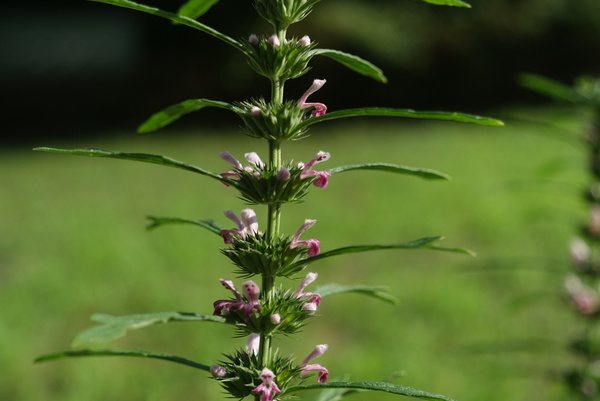
Leonurus japonicus (Oriental motherwort, "Mehajiki")
Japanese name: メハジキ (目弾)
Scientific name: Leonurus japonicus
[Overview]
A biennial 50–150 cm tall, found along roadsides, on waste ground, and on embankments.
The stem is square in cross section, erect, and branching.
The stem is densely covered with short white hairs.
The leaves are of two kinds: basal leaves and stem leaves.
The basal leaves are ovate-cordate, toothed or notched, and have long petioles.
The basal leaves have withered by flowering time.
The stem leaves are opposite, 5–10 cm long, and 3-lobed or divided all the way, with linear-lanceolate segments.
The underside of the leaves is densely covered with short white hairs, so it looks grayish white.
The leaves on the lower part of the stem have petioles.
The leaves on the upper part of the stem have no petioles, and are small and linear.
The pale reddish purple flowers grow several at a time in the axils of the upper leaves.
The corolla is lipped, 10–13 mm long, and densely covered with short white hairs on the outside.
The calyx is tubular and 5-lobed, with the tips of the lobes becoming spiny.
The fruit is a schizocarp.
[Uses]
The whole plant is called yakumoso and is used as a crude drug.
[Notes]
The Japanese name is said to come from a children's game in which a stem was propped between the upper and lower eyelids to hold the eyes wide open.
Details
Japanese: メハジキ(目弾)、ヤクモソウ(益母草)
Translated from our Japanese encyclopedia. If anything differs, the Japanese page is correct.