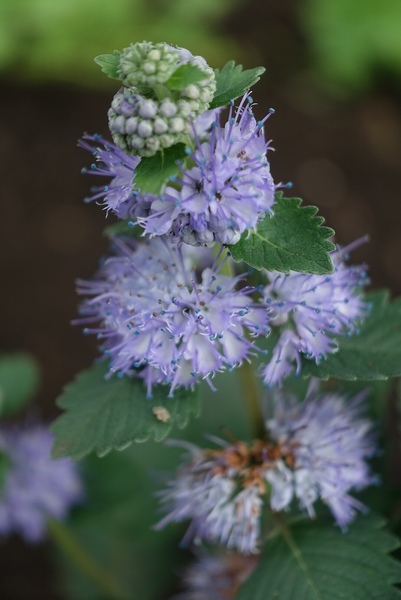
Japanese name: ダンギク(段菊) Scientific name:Caryopteris incana
[Overview]
A subshrub 20–60 cm tall, growing on sunny rocky ground.
Soft hairs cover the whole plant, giving it a gray-green appearance.
The lower part of the stem becomes woody.
The leaves are simple and opposite, ovate, 2.5–6 cm long and 1.5–3 cm wide, and densely hairy on the underside.
The leaf margins have coarse serrations.
Cymes are borne in opposite pairs at each node in the upper part of the stem, forming a conical flower spike overall.
The flowers are blue-purple and two-lipped, and the stamens and style protrude straight out of the flower.
The fruit is a schizocarp.
[Uses]
The whole plant or the roots are used medicinally.
[Cultivation]
Propagate from seed, by division, or by shoot cuttings.
It prefers a sunny site with well-drained soil.
In poor light it becomes leggy and flowers poorly.
For potted plants, water thoroughly when the soil surface dries; for plants in the ground, rainfall is sufficient unless summer brings a long spell of sunny weather and the soil dries out.
If fertilizer is applied at planting, no further fertilizing is particularly necessary, but for potted plants liquid fertilizer may be given while watching growth.
There are no particular pests or diseases.
[Notes]
The Japanese name comes from the way the flowers are borne in tiers.