
Plant Encyclopedia

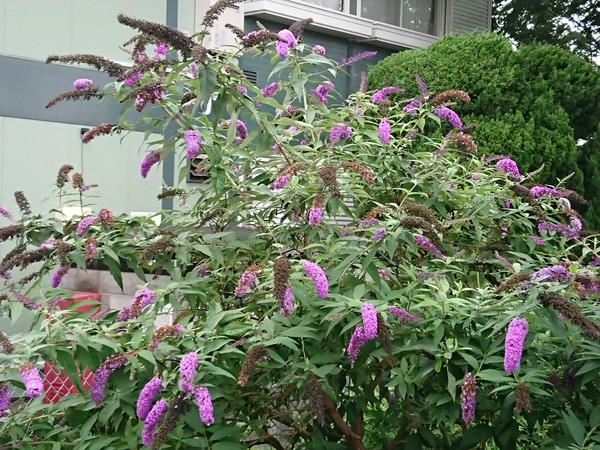
Buddleja davidii ("Fusafujiutsugi")
Japanese name: フサフジウツギ (房藤空木)
Scientific name: Buddleja davidii
[Overview]
A deciduous shrub 1.5–3 m tall.
The stem is round in cross section, and young branches are densely covered with stellate hairs.
The leaves are simple and opposite, elliptical, 8–17 cm long and 2–5.5 cm wide, with a tail-like pointed tip.
The underside of the leaf is densely covered with stellate hairs and tinged with white.
The leaf margin has teeth.
The nodes at the leaf base have semicircular stipule-like projections.
Panicles at the branch tips bear many flowers, which are borne on one side.
The axis of the inflorescence is densely covered with stellate hairs.
The flowers are tubular, 1–1.2 cm long, with a 4-lobed tip, and pale reddish purple, but there are many garden cultivars with various flower colors.
The fruit is an oblong capsule 4–5 mm long.
[Uses]
Although it is a poisonous plant, the branches, leaves and root bark are used medicinally.
[Cultivation]
Propagate by cuttings.
It prefers a sunny, well-drained site and fertile soil.
Because the roots are coarse, it dislikes being transplanted.
For potted plants and plants that have been in the ground less than 2 years, water thoroughly when the soil dries; for established plants in the ground, rainfall is sufficient unless summer brings a long spell of sunny weather and the soil becomes severely dry.
Fertilizer is not particularly necessary.
The branches grow vigorously and the shape easily becomes untidy, and when branches are too crowded, flowering suffers and aphids appear, so in March prune the branches that grew the previous year, dead branches and crowded parts.
Flower buds form on branches that grow in spring, so finish pruning before the branches begin to extend.
Pests include aphids and borers (larvae of longhorn beetles).
Details
Translated from our Japanese encyclopedia. If anything differs, the Japanese page is correct.