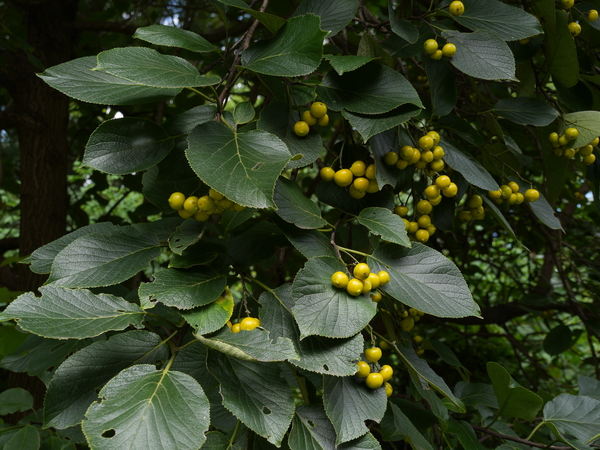
Japanese name: マルバチシャノキ(丸葉萵苣木) Scientific name:Ehretia dicksonii
[Overview]
A small deciduous tree 4–10 m tall, found mainly along the coast.
The bark is grayish brown with a thickly developed corky layer, deeply fissured lengthwise and peeling off in rectangular pieces, resembling persimmon bark.
The leaves are simple and alternate, broadly elliptic to broadly obovate, 6–17 cm long and 5–12 cm wide, thick in texture, with toothed margins.
The upper surface is dark green and glossy, with coarse hairs that make it markedly rough.
The underside is densely covered with short hairs, and the veins are prominent.
The petioles are 2–4 cm long.
Corymb-like inflorescences at the branch tips bear many dense flowers.
The flowers are white, and the corolla is 5-lobed with the lobes curving back.
The fruit is a spherical drupe about 1–1.5 cm across, ripening yellow.
[Uses]
The young leaves have a flavor like chisha (lettuce) and can be eaten.
The fruit is also sweet and can be eaten.
[Cultivation]
Propagate from seed.
It prefers sunny, well-drained, fertile soil with moderate moisture.
It dislikes dryness, so water if sunny weather continues in summer and the soil dries out.
It is somewhat intolerant of pruning, so it is better to enjoy its natural form.
Scale insects can occur.