
Plant Encyclopedia

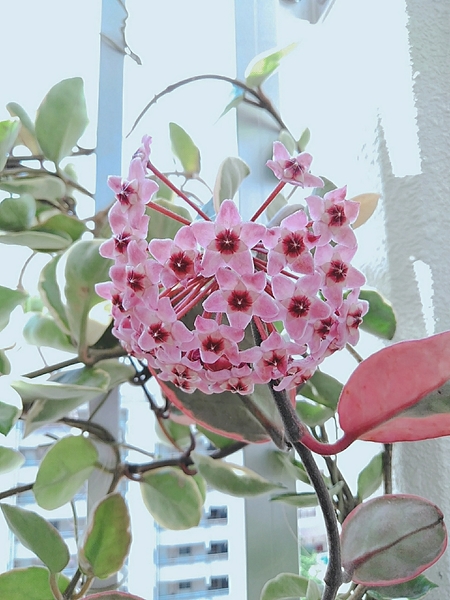
Hoya carnosa (porcelainflower, "Sakuraran")
Japanese name: サクララン (桜蘭)
Scientific name: Hoya carnosa
[Overview]
An evergreen climbing herb found in forests.
The stems are succulent, but the base becomes woody.
The leaves are simple and opposite, elliptic, 5–10 cm long and 3–5 cm wide, succulent and glossy.
The undersides of the leaves are hairy.
The leaf margins are entire.
The petiole is 1–1.5 cm long.
Dense flowers are borne in hemispherical inflorescences arising from the leaf axils.
The inflorescence stalk is thick and 2–3 cm long, and the flower stalks are 2–2.5 cm long.
The flowers are white tinged with crimson, 1.2–1.5 cm across, star-shaped with 5 lobes, succulent and waxy in texture.
The corona is red and opens in a star shape.
The flowers are fragrant.
The fruit is a linear follicle 10–14 cm long, tinged with red.
The seeds have long white hairs.
[Uses]
The leaves are used medicinally.
[Cultivation]
Propagate from seed, by cuttings, or by layering.
It tolerates temperatures down to about 5°C, but it is safer for the winter minimum temperature to be about 10°C.
It prefers well-drained soil and can even be planted in sphagnum moss alone.
Strong direct sunlight in midsummer causes leaf scorch, so place it in a sunny spot from autumn to spring and in an airy, partially shaded spot in summer.
If the light is too poor, it becomes leggy and flowers poorly.
When watering, take care that the planting medium does not become too wet; from spring to autumn water when the surface of the medium dries, and keep it on the dry side in winter.
It prefers an environment with high humidity, so mist the leaves with a sprayer during dry periods.
From spring to autumn, give liquid fertilizer once every two weeks.
Pests include scale insects and nematodes.
Details
Japanese: サクララン(桜蘭)
Translated from our Japanese encyclopedia. If anything differs, the Japanese page is correct.