EVERGREEN

Plant Encyclopedia

Catharanthus roseus

Catharanthus roseus (Madagascar periwinkle, "Nichinichiso")

Japanese name: ニチニチソウ (日日草)
Scientific name: Catharanthus roseus

Catharanthus roseus

[Overview]
A somewhat succulent subshrub 30–50 cm tall, but it is treated as an annual.
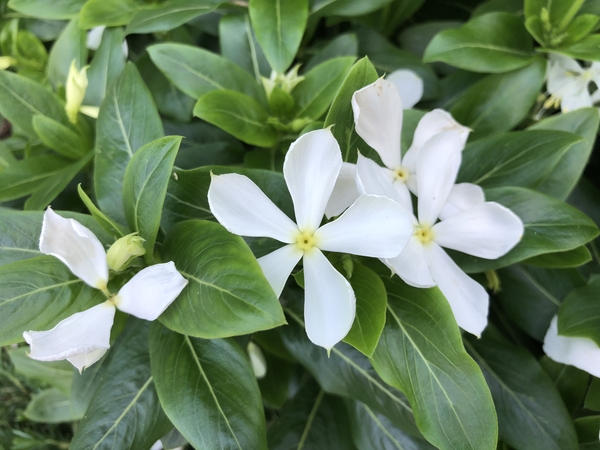
The leaves are simple and opposite, elliptic to oblong.
The leaves are glossy with entire margins.
The flowers are borne singly in the leaf axils, salverform and 5-lobed.
White or crimson flowers bloom one after another.
The fruit is a cylindrical follicle.
Garden cultivars include dwarf and creeping types.

[Uses]
Although poisonous, it is used as a folk medicine in various tropical regions.

[Cultivation]
It prefers sunny, well-drained soil.
With insufficient sunlight it becomes leggy and falls over easily.
It dislikes excess moisture, so water when the soil surface dries.
During the growing season, give liquid fertilizer or chemical fertilizer once a week.
It can overwinter if kept at 10°C or above.
Pests and diseases include damping-off and aphids.

Details

Names
English: Madagascar periwinkle, rose periwinkle, rosy periwinkle, old maid, Cayenne jasmine
Japanese: ニチニチソウ(日日草)、ニチニチカ(日日花)
Life form
Annual, Subshrub
Habit
Terrestrial
Flowering season
June, July, August, September
Distribution or origin
Madagascar
Height
3000–5000 mm
Leaf shape
Simple leaf (unlobed)
Leaf arrangement
Opposite
Leaf margin
Entire
Inflorescence
Solitary
Flower color
Purple, Pink, White, Multicolor
Leaf color
Green
Availability of seeds and plants
Low
Form sold
Seedlings
Sun exposure
Full sun
Water needs
Moderate
Soil needs
Required
Tolerance
Heat tolerance, Cold intolerance
Suitable uses
Potted plant, Flower bed, Parks and gardens, Container, Balcony, Hanging basket
Diseases
Damping-off
Pests
Aphids
Uses
Medicinal
Japan Flower Trade Code
14376

Translated from our Japanese encyclopedia. If anything differs, the Japanese page is correct.

Sponsored