
Plant Encyclopedia

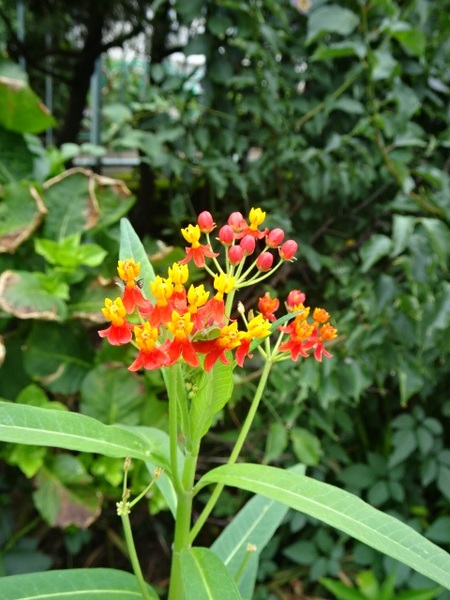
Asclepias curassavica (tropical milkweed, "Towata")
Japanese name: トウワタ
Scientific name: Asclepias curassavica
[Overview]
An evergreen perennial or subshrub 0.3–2 m tall, but because it is sensitive to cold, it is treated as an annual in Japan.
A milky white sap comes out when the stem or leaves are damaged.
The stem has coarse hairs.
The leaves are simple and opposite, oblong-lanceolate, 5–10 cm long, with entire margins.
Umbel-like cymes at the stem tips and in the leaf axils bear 10–20 red to deep orange flowers.
The corolla is 5-lobed and strongly reflexed, and has a yellow corona with needle-like projections.
The fruit is a spindle-shaped follicle 5–10 cm long, which when ripe releases many seeds with long silky hairs.
[History]
The Honzo Zufu records that it arrived in Edo in 1842 (Tenpo 13).
[Uses]
Although it is a poisonous plant, the flowers, leaves and roots are used medicinally.
[Cultivation]
Propagate from seed or by shoot cuttings.
The optimum germination temperature is high, 20–25°C.
If grown in a pot and brought indoors to a warm room in winter, it can be cultivated as a perennial.
It prefers fertile sites with good sunlight and drainage.
For potted plants, water thoroughly when the soil surface dries; for plants in the ground, rainfall is sufficient.
It is sensitive to excess moisture, so take care not to overwater.
If overwintering it, keep it on the dry side in winter.
Fertilizer is not particularly necessary for plants in the ground; for potted plants, apply slow-release fertilizer regularly from spring to autumn.
The plant grows tall, so set up stakes to keep it from falling over.
Pests include spider mites and aphids.
Details
Japanese: トウワタ
Translated from our Japanese encyclopedia. If anything differs, the Japanese page is correct.