
Plant Encyclopedia

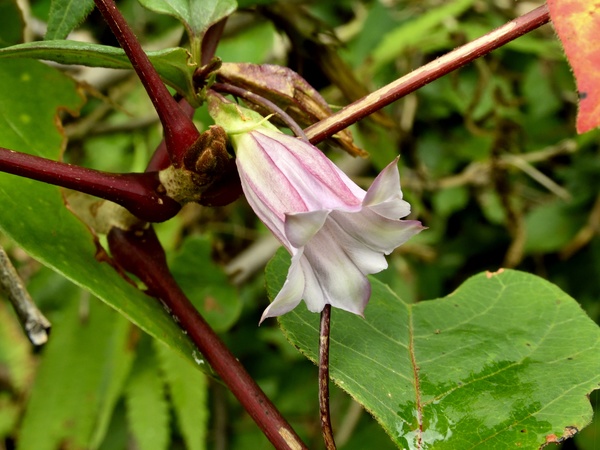
Tripterospermum japonicum var. japonicum ("Tsururindo")
Japanese name: ツルリンドウ (蔓竜胆)
Scientific name: Tripterospermum japonicum var. japonicum
[Overview]
A climbing perennial found in mountain forests.
The stem is tinged purple and grows 40–200 cm long.
The leaves are simple and opposite, 3–7 cm long, somewhat triangular, with 3 conspicuous veins.
The leaf margins are entire.
The leaf stalk is 0.5–1 cm long.
The flowers are borne singly at the branch tips and in the leaf axils.
The corolla is tubular-bell-shaped, 2.5–3 cm long, 5-lobed at the tip, and pale purple.
There are small accessory lobes between the corolla lobes, and there are no nectaries at the base of the ovary.
The calyx tube is 0.6–0.8 cm long, and the calyx lobes are linear-lanceolate.
The fruit is a spherical berry about 8 mm across, ripening to reddish purple.
[Uses]
The whole plant is used medicinally.
[Cultivation]
Propagate from seed, by division, or by shoot cuttings.
The best time for shoot cuttings is May–June.
It prefers fertile soil with good sunlight, drainage, water retention and aeration.
Direct summer sun scorches the leaves, so move potted plants to bright shade; for plants in the ground, plant them under deciduous trees or provide 50% shading in summer.
It is cold-hardy, but in winter it is best protected with straw mulch or similar to keep it from severe freezing and cold winds.
It dislikes dryness and the leaves are damaged when it dries out, so water once a day, in the evening when the temperature drops in summer.
However, if it becomes too wet, the roots will rot.
The leaves turn yellow when fertilizer is lacking.
Apply slow-release fertilizer as basal fertilizer, and apply liquid fertilizer twice a month in spring and autumn.
Set up stakes for the vines to twine around.
Pests and diseases include rust, root-knot nematodes and aphids.
Details
Translated from our Japanese encyclopedia. If anything differs, the Japanese page is correct.