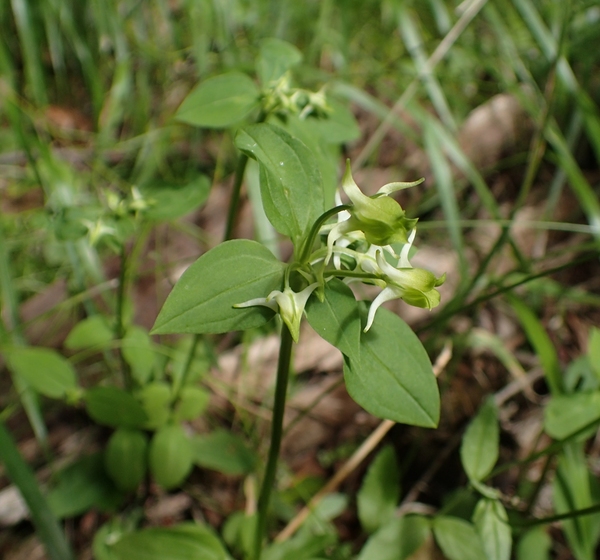
Japanese name: ハナイカリ(花錨、花碇) Scientific name:Halenia corniculata
[Overview]
An annual or biennial 10–60 cm tall, found in sunny places in the mountains.
The stem has 4 ridges and branches slightly.
Leaves are simple and opposite, oblong, 2–6 cm long and 1–2.5 cm wide, with a pointed tip.
The leaves may be in whorls of 4 near the stem tip.
The leaf stalks are short, and in the upper part of the stem the leaves are almost stalkless.
Cymes arise from the stem tip and leaf axils.
The flowers are pale yellow; the corolla is 4-lobed, and at the base there are 4 pale yellow to white spurs, giving an anchor shape.
The calyx is deeply 4-lobed.
The fruit is a lanceolate capsule.
[Cultivation]
Propagate from seed.
It prefers a sunny, well-drained place.
For potted plants, water thoroughly when the soil surface dries; for plants in the ground, rainfall is sufficient.
If base fertilizer is applied, no further fertilizing is particularly necessary.
There are no particular pests or diseases.