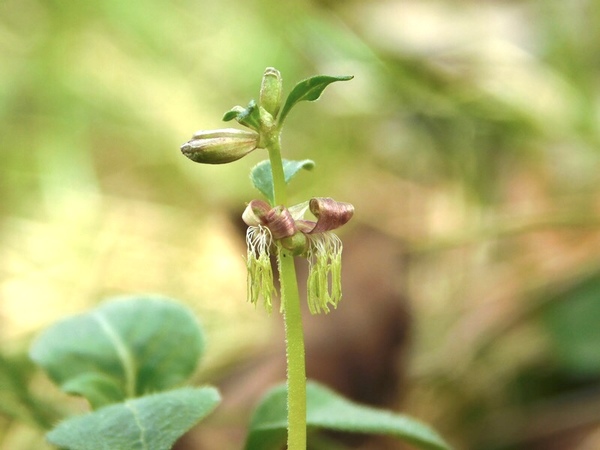
Japanese name: ヤマトグサ(大和草) Scientific name:Theligonum japonicum
[Overview]
A perennial 10–30 cm tall, found in moist places in mountain forests.
The stem usually has one row of short hairs.
After flowering, the side shoots at the base of the stem elongate and creep along the ground, forming young plantlets at their tips.
The leaves are simple, opposite on the lower part of the stem and alternate on the upper part, ovate, 1–3 cm long and 0.5–2 cm wide, with short hairs on the upper surface and margin, and membranous stipules.
There are male and female flowers, both pale green, borne opposite the leaf-like bracts on the upper part of the stem.
The male flowers are borne one or two at a time; the 3 tepals curve backward, and the 20–25 stamens hang down conspicuously.
The female flowers are very small and stalkless.
The fruit is a narrowly obovate achene.
[Notes]
Collected in Kochi by Tomitaro Makino in Meiji 17 (1884), it became the first plant from Japan to be described and published by a Japanese person.