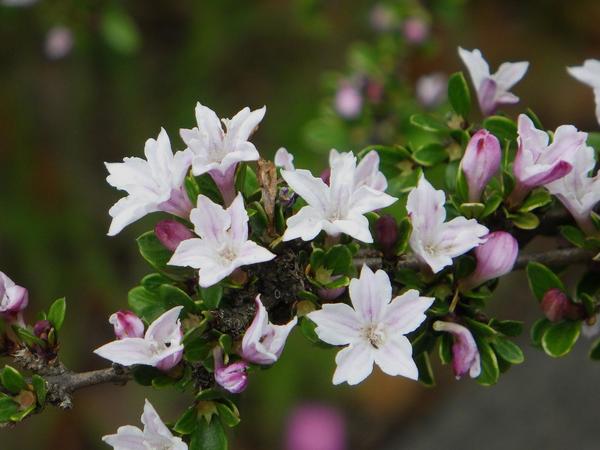
Japanese name: ハクチョウゲ(白丁花) Scientific name:Serissa japonica
[Overview]
An evergreen shrub 0.5–1 m tall.
The thin branches branch freely, spread sideways, and grow densely.
Young branches are blackish purple with short hairs.
Leaves are simple and opposite, elliptic to lanceolate, 0.5–2 cm long and 0.2–0.5 cm wide, with entire margins.
Two stipules are borne at each node, each deeply 3-lobed.
1–2 flowers are borne on short branches arising at the branch tips and leaf axils.
The flowers are white to pale reddish purple and funnel-shaped, with a shallowly 5-lobed tip.
The fruit is a capsule, but plants in Japan almost never set fruit.
[Uses]
It is used medicinally.
[Cultivation]
Propagate by division or cuttings.
It prefers a sunny, well-drained site.
For potted plants, water thoroughly when the soil surface dries; for plants in the ground, rainfall is sufficient.
In winter, apply organic fertilizer as fertilizer in winter, in holes dug around the plant.
There are no particular pests or diseases.