
Plant Encyclopedia

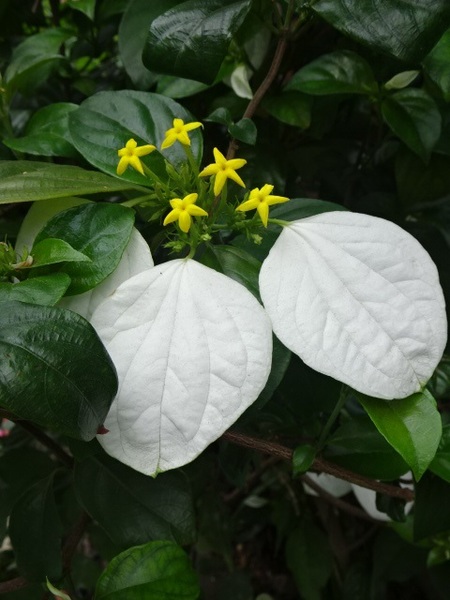
Mussaenda parviflora var. parviflora ("Konronka")
Japanese name: コンロンカ (崑崙花)
Scientific name: Mussaenda parviflora var. parviflora
[Overview]
An evergreen semi-climbing shrub found at the edges of woods, growing about 1–5 m tall.
The young branches are densely covered with short appressed hairs.
The leaves are simple and opposite, elliptic to lanceolate, 6–12 cm long and 2–4 cm wide, with entire margins.
Both surfaces of the leaves bear sparse short appressed hairs, which are especially numerous on the veins of the underside.
The petiole is 1–2 cm long and densely covered with short appressed hairs.
There are 4 stipules at each node, narrowly triangular or linear and 0.4–1 cm long.
It can flower all year round if the temperature allows, but flowering is mainly in spring in its native habitat and in summer in Honshu.
It is dioecious.
The flowers have the same form on male and female plants.
Short corymbs borne at the branch tips and in the leaf axils near the branch tips carry 5–50 flowers.
The corolla is yellow and funnel-shaped, 1.1–1.5 cm long.
One of the calyx lobes of the flowers on the outside of the inflorescence is white and large, resembling a petal.
The fruit is an elliptical berry.
[Cultivation]
Propagate by cuttings.
It prefers sunny, well-drained, fertile soil.
In poor sunlight it flowers poorly.
It is sensitive to cold and drops its leaves at 15°C or below, so it is better grown in a pot and brought indoors in winter.
Strong wind also damages the flowers, so a place with little wind is better.
From spring to autumn, water thoroughly when the soil surface dries, and keep on the dry side in winter.
From spring to autumn, apply a slow-release chemical fertilizer with equal amounts of the three components.
Pests and diseases include aphids, spider mites and scale insects.
Details
Translated from our Japanese encyclopedia. If anything differs, the Japanese page is correct.