
Plant Encyclopedia

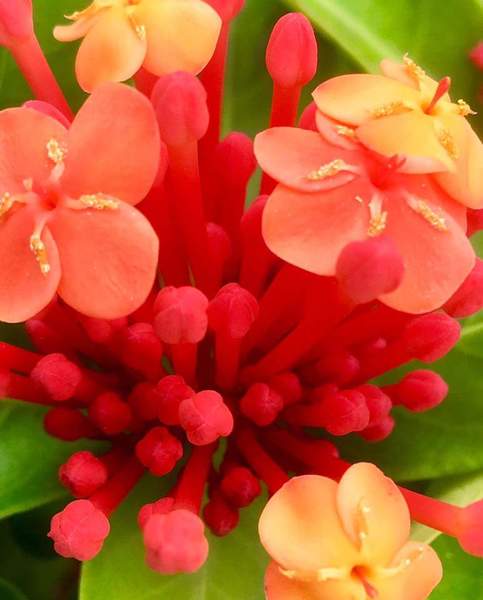
Ixora chinensis ("Santanka")
Japanese name: サンタンカ (山丹花)
Scientific name: Ixora chinensis
[Overview]
An evergreen shrub 0.8–2 m tall.
The leaves are simple and opposite, oblong, 6–18 cm long and 3–6 cm wide.
The leaf margins are entire, and the petiole is short, 5 mm or less.
It flowers all year round as long as the temperature allows.
Well-branched, semicircular cymes 5–10 cm across bear densely packed flowers.
The flowers are red to orange and 2–3 cm long; the corolla is 4–5-lobed, and the lobe tips are rounded.
The flower stalks are also red.
[History]
It came to Japan via Okinawa in the middle of the Edo period.
[Cultivation]
Propagate by cuttings.
Rooting is easy at 20°C or above; cut growth from the previous year into pieces of 2–3 nodes each and insert them.
It prefers sunny, well-drained, humid conditions and fertile, slightly acidic soil.
A minimum of 10°C is needed to overwinter and 15°C or above to see flowers, so in cold regions bring it indoors to a sunny place in winter.
In summer it grows better if moved to partial shade, such as under a tree.
For potted plants, water thoroughly from spring to autumn when the soil surface dries, and keep on the dry side in winter.
For plants in the ground, watering is unnecessary unless sunny weather continues and the soil dries out.
From spring to autumn, apply slow-release fertilizer placed on the soil about once every 2 months.
Cutting back right after flowering produces a second flowering in autumn.
Pests and diseases include scale insects and aphids.
Details
Translated from our Japanese encyclopedia. If anything differs, the Japanese page is correct.