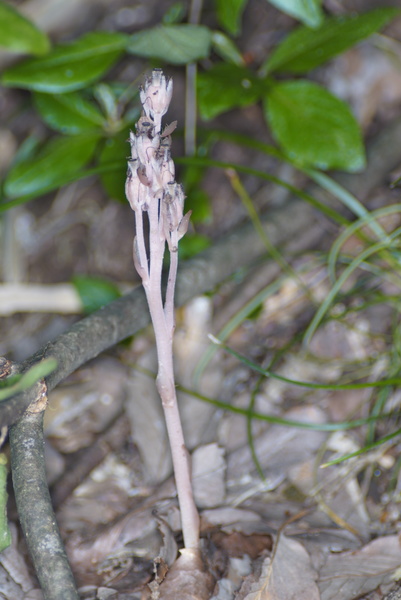
Japanese name: シャクジョウソウ(錫杖草) Scientific name:Hypopitys monotropa
[Overview]
A mycoheterotrophic plant 10–20 cm tall, rarely found in moist, humus-rich shade on the floor of mountain forests.
It is a perennial.
It has no chlorophyll, and the whole plant is pale yellowish brown.
Underground there is a spherical tuber formed of short underground stems and roots densely tangled together.
Several thick aerial stems rise upright from the tuber.
The stems are unbranched, with stiff bristles in the upper part and alternate scale leaves.
The scale leaves are long ovate with pointed tips.
The flowers are borne 4–8 in a raceme at the stem tip, hanging downward, and are tubular, about 1–1.5 cm long.
There are 4–5 sepals, oblong, with irregular teeth in the upper part and stiff bristles on the outside.
There are 4–5 petals, oblong and slightly longer than the sepals, with irregular teeth in the upper part and long hairs on both surfaces.
The fruit is a broadly elliptic capsule, borne upward.