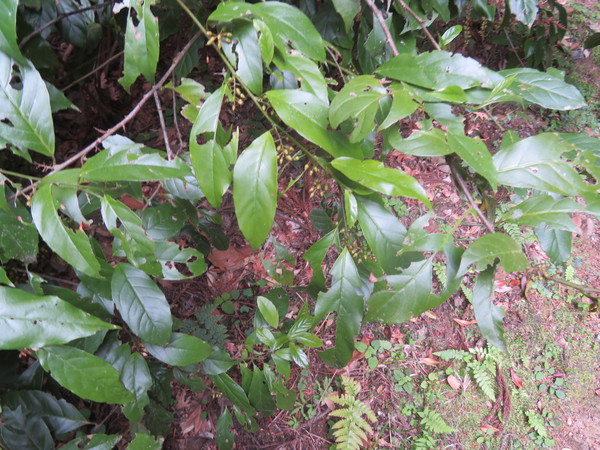
Japanese name: イズセンリョウ(伊豆千両) Scientific name:Maesa japonica
[Overview]
An evergreen shrub about 1 m tall, found in forests in the mountains.
The branches grow vigorously, and young branches are green.
Leaves are simple and alternate, oblong, 5–17 cm long and 2–5 cm wide, hairless on both sides, with a glossy upper surface.
The leaf margin has sparse low teeth or is entire.
The petiole is 1–1.5 cm long and hairless.
The plant is dioecious.
Both male and female flowers are yellowish white and borne in racemes or panicles 1–2 cm long arising from the leaf axils.
The corolla is tubular-bell-shaped, 0.5 cm long, shallowly 5-lobed at the tip, with the lobes erect or ascending.
The corolla tube is more than 3 times as long as the corolla lobes.
The bracteoles at the base of the calyx are broadly ovate with rounded tips.
The fruit is a spherical berry 0.5 cm across, milky white, enclosed by the persistent calyx, with the style remaining at the tip.
The seeds are black and ridged.
[Uses]
The roots and leaves are used medicinally.
[Notes]
It is common at Izusan Shrine in Izu, and the name is said to come from its fruits resembling those of Senryo.