
Plant Encyclopedia

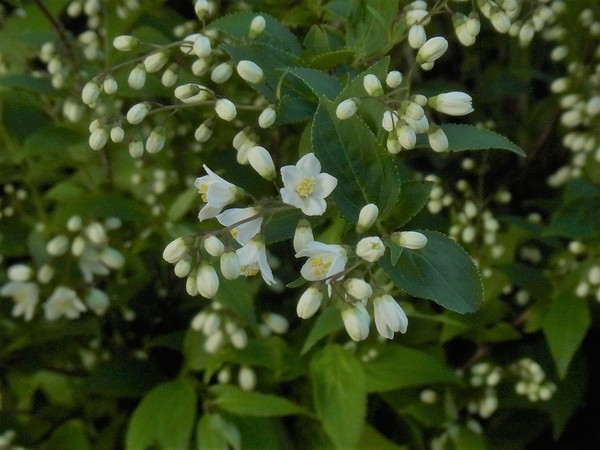
Deutzia crenata ("Utsugi")
Japanese name: ウツギ (空木)
Scientific name: Deutzia crenata
[Overview]
A deciduous shrub about 2 m tall, found in sunny places such as cliffs and roadsides in hills and mountains.
The trunk and branches are hollow.
It branches freely.
Young branches are tinged reddish brown and hairy.
Leaves are simple and opposite, varying in size and shape, ovate to ovate-lanceolate; leaves on flowering branches are about 4–10 cm long and 2.5–4 cm wide.
Both surfaces of the leaves have stellate hairs and are rough, and the margins have fine serrations.
The petiole is 2–7 cm long and fairly densely covered with stellate hairs.
Panicles are produced at the branch tips.
The inflorescence is densely covered with stellate hairs, and the leaves below the inflorescence have petioles.
The flowers are white, bell-shaped, 5-petaled, and 1 cm across.
The calyx is densely covered with stellate hairs.
The fruit is a woody, bowl-shaped capsule 4–7 mm across, with the style remaining at the tip.
[Cultivation]
Propagate by cuttings.
It prefers sunny, well-drained, well-ventilated, fertile soil.
It tolerates partial shade and dryness.
It is hardy and grows well even if left alone.
For potted plants, water thoroughly when the soil surface dries.
For plants in the ground, rainfall is sufficient.
Apply organic fertilizer in winter by burying it in deep holes dug around the plant.
When applying slow-release fertilizer after flowering as a thank-you fertilizer, dig holes in the same way.
Prune right after flowering, in June.
Flower buds for the following year form once summer arrives, so avoid pruning then.
Powdery mildew may occur.
[Notes]
Because the branches are hollow, the name is a corruption of utsurogi (hollow tree).
Details
Translated from our Japanese encyclopedia. If anything differs, the Japanese page is correct.