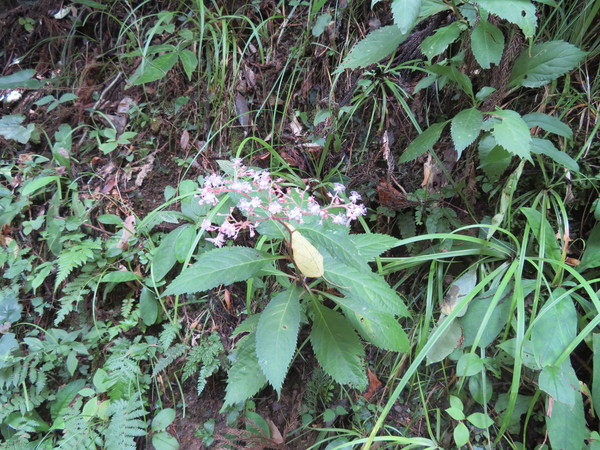
Cardiandra alternifolia var. alternifolia("Kusaajisai")
Japanese name: クサアジサイ(草紫陽花) Scientific name:Cardiandra alternifolia var. alternifolia
[Overview]
A perennial 20–80 cm tall, found in slightly moist places in woods and on rocks.
Several stems rise upright from the underground stem each year.
The stems are usually unbranched and covered with white hairs.
Leaves are simple and alternate, lanceolate to elliptic, 10–20 cm long and 3–6 cm wide, with white hairs on both surfaces.
The leaf margin is toothed.
The leaves have petioles.
Cymes at the stem tips have axes covered with coarse white hairs.
The inflorescence consists of many bisexual flowers in the center and a few ornamental flowers around the edge.
The bisexual flowers are white to pale pink, 0.6–0.7 cm across, with about 20 stamens.
The ornamental flowers are 3-petaled, white to pale reddish purple.
The fruit is a capsule.
[Cultivation]
Propagate from seed or by cuttings.
It prefers partial shade and well-drained, moisture-retentive soil.
Water thoroughly when the soil surface dries.
In spring, place slow-release fertilizer on the soil.
There are no particular pests or diseases.