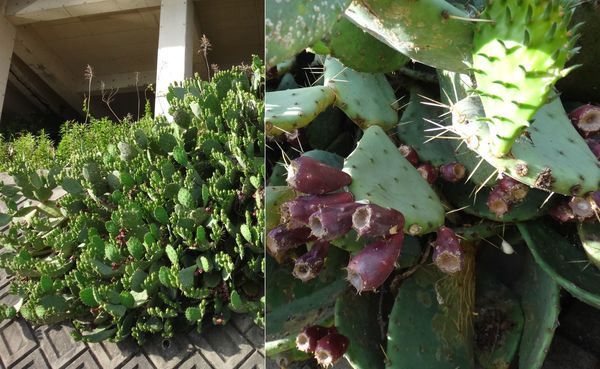
Japanese name: ウチワサボテン Scientific name:Opuntia ficus-indica
[Overview]
A cactus 4–5 m tall.
It produces many stem segments.
The stem segments grow up to 50 cm long and are thick, oblong to spatulate-oblong, and bluish green; the areoles are small and there are usually no spines.
Yellow spines and many glochids are produced but fall off later.
Young stem segments bear wedge-shaped leaves about 3 mm long.
The flowers are solitary, 7–10 cm across, and pale yellow.
The fruit is about 5–9 cm long, ripens red, and is edible.
[Uses]
The fruit and young stem segments are eaten.
[Cultivation]
Propagate from seed or by cuttings.
It can overwinter outdoors in regions without frost.
It prefers a sunny, well-drained place.
Its shape catches the wind easily, so avoid places exposed to strong wind.
It is best kept on the dry side; for potted plants, water thoroughly after the soil dries from spring to autumn, and reduce watering in winter.
For plants in the ground, rainfall is sufficient.
If a base fertilizer is applied, no further fertilizing is particularly necessary.
Scale insects can occur.