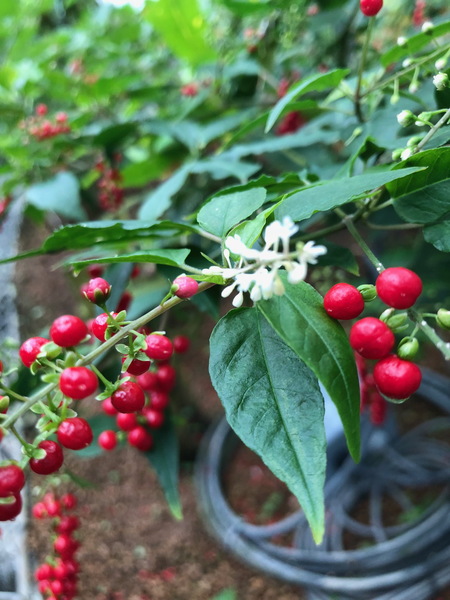
Japanese name: ジュズサンゴ Scientific name:Rivina humilis
[Overview]
An evergreen perennial growing 0.4–2 m tall.
It is semi-vining and shrub-like, with green stems that branch freely in the upper part.
Leaves are simple and alternate, ovate, 3–8 cm long and 2–4 cm wide.
The leaf stalk is 1–3 cm.
Racemes emerge from the leaf axils and bear many flowers about 4 mm across.
The flowers have no petals; the petal-like calyx spreads in a cross shape and is white with pink-tinged tips.
The fruit is a spherical, glossy berry about 5 mm across, ripening red.
[History]
It is said to have first entered Japan on Chichijima in the Ogasawara Islands during the Meiji period, and it has become naturalized.
[Uses]
The fruit is used as a dye.
[Cultivation]
Propagate from seed.
It also spreads readily from self-sown seed.
It is not very cold-hardy, but in areas without frost it can overwinter outdoors, and even if the aboveground part dies back, it will sprout again the following spring as long as the roots do not freeze.
It prefers fertile, acidic soil in a sunny, well-drained site.
Water thoroughly when the soil surface dries, and take care not to let it dry out in summer.
Use fertilizer sparingly, only applying liquid fertilizer from spring to autumn.
There are no particular pests or diseases.