
Plant Encyclopedia

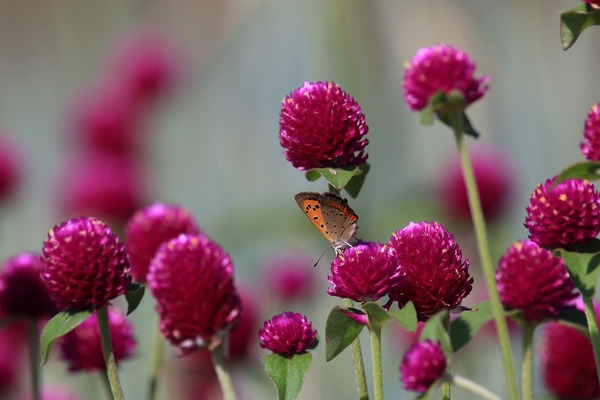
Gomphrena globosa (globe amaranth, "Sennichiko")
Japanese name: センニチコウ (千日紅)
Scientific name: Gomphrena globosa
[Overview]
An annual about 50 cm tall.
The whole plant is covered with coarse hairs.
Leaves are simple and opposite, elliptic, 5–10 cm long and about 4 cm wide, with short petioles.
One or two flower heads 2–3 cm across are borne at the stem tips.
The flowers are very small, and the colored, dry bracts are conspicuous.
The bracts are purplish red, pink, white and so on, and do not fade for a long time.
The fruit is a utricle.
[Uses]
It is used as a dried flower, and abroad it is also used for leis and wreaths.
It is also used medicinally.
[Cultivation]
Propagate from seed.
The optimum temperature for germination is 20–25°C.
The seed surface is covered with cottony hairs, so rub these off thoroughly before sowing.
As long as the site is sunny, well drained and well ventilated, it is not particular about soil.
In poor sunlight, flowering is poor.
It prefers a somewhat dry place and dislikes excess moisture, so move potted plants out of the rain during long rainy spells.
Be careful not to overwater; for potted plants, water thoroughly when the soil surface dries.
For plants in the ground, rainfall is sufficient.
Fertilizer is not particularly necessary if base fertilizer is thoroughly dug in.
Pests and diseases include damping-off and spider mites.
Damping-off occurs easily, especially in young seedlings.
Details
Japanese: センニチコウ(千日紅)、センニチソウ(千日草)
Translated from our Japanese encyclopedia. If anything differs, the Japanese page is correct.