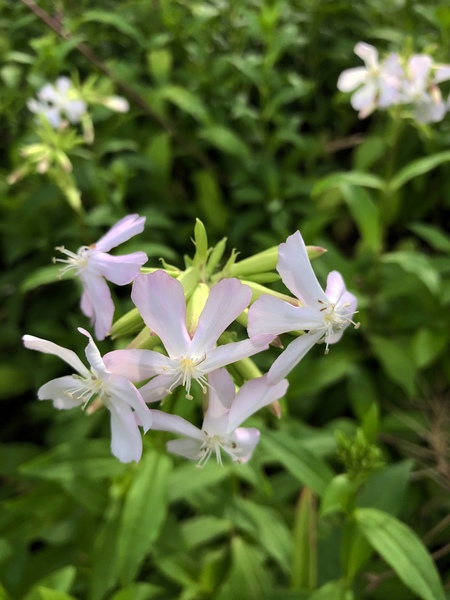
Japanese name: サボンソウ Scientific name:Saponaria officinalis
[Overview]
A perennial 50–80 cm tall.
It spreads by rhizomes.
The stem is erect, unbranched, and often tinged with red.
The leaves are simple and opposite, oblong, 4–12 cm long, with three conspicuous veins.
The leaf margin is entire.
Cymes at the stem tips bear pale pink to white flowers.
The corolla is radially 5-lobed and opens flat, with notched lobe tips.
The flowers are fragrant, with a strong scent at night.
The fruit is a capsule.
[History]
It was introduced to Japan in the early Meiji era.
[Uses]
The leaves contain the glycoside saponarin, and were used as a natural soap by soaking them in water and rubbing them.
The roots contain saponin, and the leaves and rhizomes are used medicinally.
[Cultivation]
Propagate from seed, by division, or by shoot cuttings.
As long as the site is sunny and well drained, it is not particular about soil, and it is hardy and grows well.
It tolerates dryness and dislikes excess moisture, so for potted plants water thoroughly after the soil has dried, and for plants in the ground rainfall is sufficient.
For potted plants, apply a small amount of slow-release fertilizer in spring and autumn; for plants in the ground, none is particularly needed.
There are no particular pests or diseases.