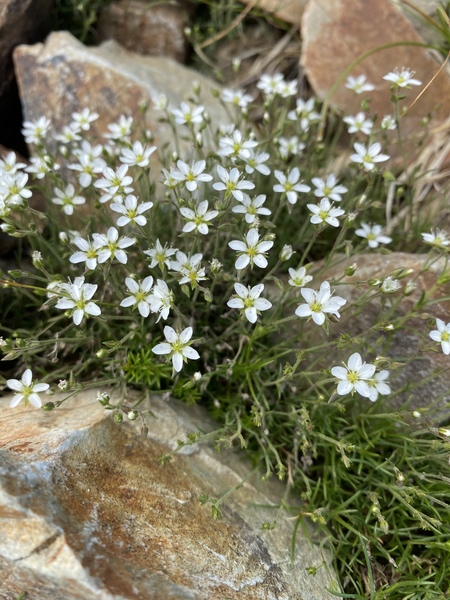
Japanese name: ホソバツメクサ(細葉爪草) Scientific name:Minuartia verna var. japonica
[Overview]
A perennial 4–13 cm tall, found on gravelly and rocky ground in alpine areas and preferring limestone and ultrabasic rock sites.
It grows in mats.
There are non-flowering stems and flowering stems, with short hairs and glandular hairs on the upper part.
The leaves are opposite, needle-shaped to linear, 0.3–1 cm long, with 3 veins; the tip is sharply pointed into a short needle, and there are no hairs.
The flowers are borne in dichasial cymes at the tips of the flowering stems and are white, 5-petaled, about 0.5–0.6 cm across.
The petals are about as long as the sepals.
The sepals are long ovate to broadly lanceolate, with 3 veins and pointed tips.
The flower stalks are densely covered with glandular hairs.
The fruit is a capsule about 5 mm long.
The seeds have minute projections on the back and wavy projections around the margin.