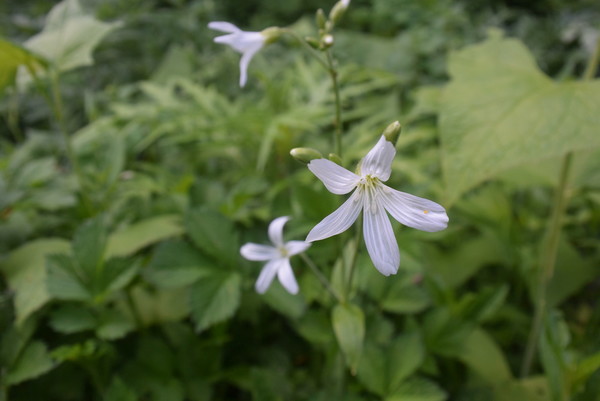
Japanese name: タガソデソウ(誰袖草) Scientific name:Cerastium pauciflorum var. amurense
[Overview]
A perennial 30–50 cm tall, found in deciduous forests and at forest edges in the mountains.
The upper part of the stem has short hairs and glandular hairs.
Leaves are simple and opposite, lanceolate, 4–9 cm long and 1–2 cm wide, with pointed tips; both surfaces have appressed hairs, and the leaf margins are also fringed with hairs.
There is no leaf stalk.
A dichasial cyme at the stem tip bears several flowers.
The flowers are white and 5-petaled, the largest of the Japanese species in the genus, about 3 cm across.
The petals are oblong-spatulate, not divided in two, and 2.5–3 times as long as the calyx.
The calyx is ovate-lanceolate to elliptic, 0.4–0.6 cm long, with glandular hairs on the outside.
The flower stalks are 2–5 cm long and have glandular hairs.
The fruit is a capsule 0.7–1 cm long, splitting into 10 at the tip.
The seeds are 1 mm across and have cylindrical projections.
[Notes]
The Japanese name is said to derive from a poem in the Kokin Wakashu: "I find the fragrance more moving than the color—whose sleeve brushed this plum by the house?"