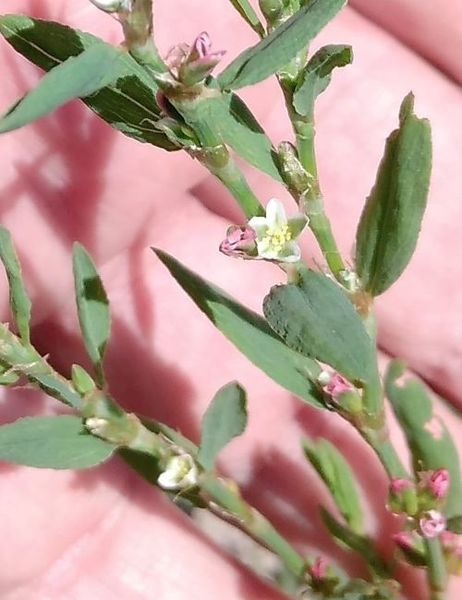
Japanese name: ミチヤナギ(道柳) Scientific name:Polygonum aviculare subsp. aviculare
[Overview]
An annual 10–40 cm tall, found on roadsides, vacant lots and in fields.
It often grows in colonies.
The stem branches well from the base.
Leaves are simple and alternate, linear-oblong to ovate, with short petioles and white, membranous leaf sheaths.
Leaves on the main stem are about 2–6 cm long and 0.5–2 cm wide, and leaves on the side branches are about 1/4–3/4 the size of those on the main stem.
The flowers grow in clusters of 2–7 in the leaf axils; they are small and have no petals, and the 5-lobed sepals look like petals.
The sepals are white inside and green outside, and the margins are sometimes tinged with red.
The fruit is an ovate, 3-ridged achene.
[Uses]
It is used medicinally.
[Notes]
The Japanese name comes from its growing by roadsides and its leaves resembling those of the willow.