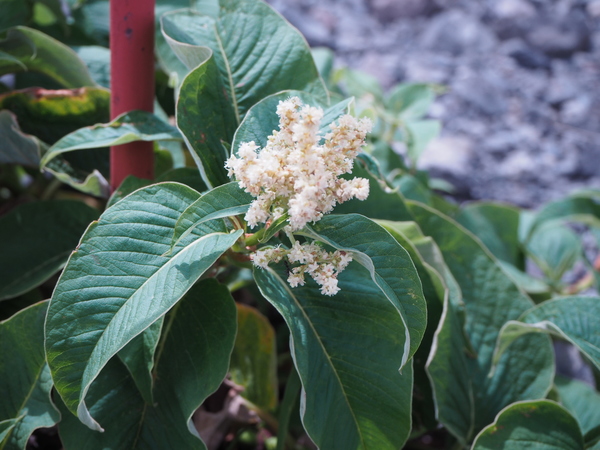
Japanese name: オンタデ(御蓼) Scientific name:Aconogonon weyrichii var. alpinum
[Overview]
A perennial 20–100 cm tall, growing on sandy and gravelly ground in the subalpine to alpine zones, often forming colonies.
It is common on Mt. Fuji.
It has a thick underground rhizome.
The stem is not much branched.
The leaves are simple and alternate, 10–20 cm long, long-ovate, with pointed tips.
The leaf margins are entire.
When young, the leaves have short hairs on both surfaces, but later become hairless, and the underside is pale green.
At the base of the petiole there is a stipular sheath 3–3.5 cm long.
The stipular sheath is membranous with longitudinal veins and is hairy.
It is dioecious.
A large conical raceme at the stem tip bears many yellowish white flowers.
The flowers have no petals, and the petal-like calyx is deeply divided into 5 lobes.
Male flowers have 8 stamens and 1 rudimentary pistil; female flowers have a style divided into 3 lobes.
The fruit is an achene about 1 cm long, with 3 broad wings, and is broadly elliptic.
In the fruiting stage, the female inflorescence takes on a reddish tinge.
It resembles Urajiro-tade, but can be distinguished by being less hairy overall, and by its hairless, pale green leaf undersides.
[Notes]
The Japanese name derives from Mt. Ontake in Kiso.