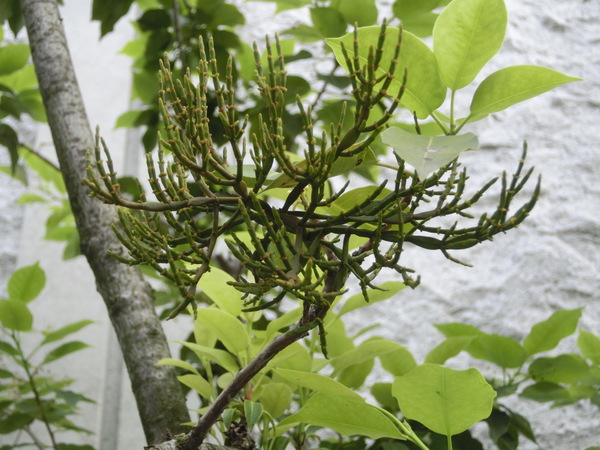
Japanese name: ヒノキバヤドリギ(檜葉宿木) Scientific name:Korthalsella japonica
[Overview]
An evergreen shrub 5–20 cm tall, often found in lowlands, growing on the branches of various evergreen broadleaf trees such as Tsubaki, Hisakaki, Nezumi-mochi and Hai-noki.
It photosynthesizes on its own, but it is a semi-parasitic plant that parasitizes trees and receives water and nutrients from them.
It branches well, and the stems are green, hairless and flat, developing wings on both sides as they age.
There are many nodes, and it breaks easily at the nodes.
The leaves are opposite but reduced to small, projection-like scale leaves whose bases widen and form a ring around the nodes.
There are male flowers and female flowers, both green and 1 mm or less, borne several at each node, with 3-lobed tepals.
The fruit is spherical, about 2 mm across, and ripens orange-yellow.
The seeds are sticky and adhere to other plants.
[Notes]
The Japanese name compares the way the stems spread to Hinoki (Japanese cypress).