
Plant Encyclopedia

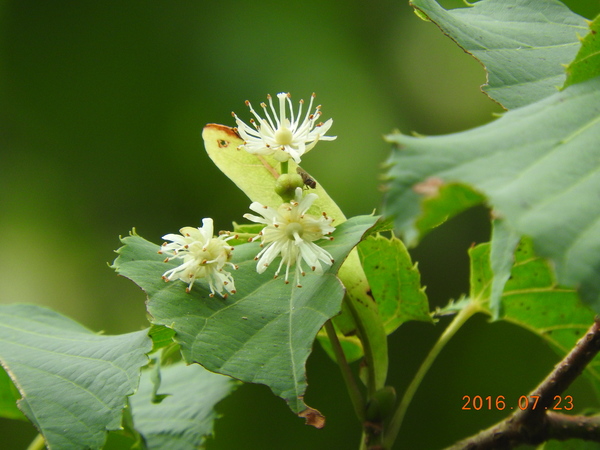
Tilia japonica var. japonica (Japanese linden, "Shinanoki")
Japanese name: シナノキ (科木)
Scientific name: Tilia japonica var. japonica
[Overview]
A deciduous tree 8–10 m tall, reaching 30 m in large specimens.
Young branches and petioles are at first covered with stellate hairs.
The leaves are simple and alternate, 4–10 cm long and 4–8 cm wide, asymmetrical and rounded, with the tip drawn out into a tail-like point.
Soft hairs grow densely at the bases of the lateral veins on the undersides of the leaves.
The leaf margins have sharp serrations.
The petioles are 2–5 cm long.
A cyme 5–8 cm long arising from a leaf axil bears more than ten yellow 5-petaled flowers.
The inflorescence has an elliptical bract 3–6 cm long, and the bract has a stalk of 1.5–2 cm.
The fruit is spherical, about 5 mm across, and densely covered with grayish-white soft hairs.
By the fruiting period the bract is about 10 cm long.
[Uses]
It is well known as a honey plant.
The mucilage of the flowers, fruits, leaves and bark is used medicinally and as a bath additive.
The fibers of the bark are used for rope and cloth, and the wood is used as building material.
[Cultivation]
Propagate from seed.
Collect ripe fruits, remove the fruit wall and sow immediately, or put the seeds in moist sand or similar so they do not dry out, seal the container, store it in a cool, dark place, and sow in the following spring.
The seeds are strongly dormant, so germination takes 1–3 years.
Seedlings tolerate shade, and it is better to grow them for several years in dense planting, such as bundles of 3 plants or mixed plantings, rather than singly.
It prefers a somewhat cool climate and dislikes heat and humidity.
It prefers fertile soil in a sunny, well-drained, well-ventilated site.
It becomes a large tree if the conditions suit it, so it needs plenty of space.
For mature trees, rainfall is sufficient, but if the soil dries out in summer and water runs short, the leaves fall early.
If basal fertilizer is applied, no further fertilizing is particularly necessary.
Pests and diseases include sooty mold and aphids.
Details
Japanese: シナノキ(科木)、サドシナノキ(佐渡科木)、チャボシナノキ(矮鶏科木)
Translated from our Japanese encyclopedia. If anything differs, the Japanese page is correct.