EVERGREEN

Plant Encyclopedia

Melia azedarach

Melia azedarach (Chinaberry, "Sendan")

Japanese name: センダン (栴檀)
Scientific name: Melia azedarach

Melia azedarach

[Overview]
A deciduous tree 7–10 m tall, growing in forests near the coast.
It spreads its branches widely.
Young branches are green and at first densely covered with stellate hairs.
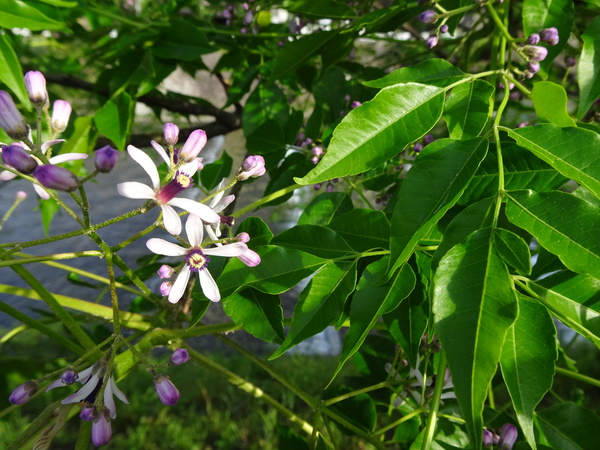
The leaves are alternate, clustered at the branch tips, and 2–3 times odd-pinnately compound.
The leaflets are ovate to ovate-oblong, 3–6 cm long and 1–2.5 cm wide, abruptly pointed at the tip, with coarse teeth on the margin.
The base of each leaflet is asymmetrical.
Compound cymes 8–13 cm long arise from the leaf axils and bear many flowers.
The flowers are pale purple with 5 petals, about 2 cm across.
There are 10 stamens, fused into a tube.
The fruit is elliptical, 1.5–2 cm long, and ripens to pale yellow.

[Uses]
The wood is used as a substitute for Kiri and Keyaki, for geta (wooden clogs), musical instruments, furniture and so on.
The bark and fruit are used medicinally.

[Cultivation]
Propagate from seed.
It prefers a sunny, well-drained site.
It is easy to grow, but as it is a plant of warm regions it is not suited to cold areas.

[Notes]
The "Sendan" in the proverb "Sendan wa futaba yori kanbashi" refers to Byakudan.

Details

Names
English: Chinaberry, Persian lilac, pride of India, bead-tree, white cedar, Cape lilac, Indian lilac, syringa berrytree
Japanese: センダン(栴檀)、アウチ(楝)、オウチ
Life form
Tree
Evergreen / deciduous
Deciduous
Leaf type
Broadleaf
Habit
Terrestrial
Planting (or sowing) season
April, May
Flowering season
May, June
Fruiting season
October, November
Distribution or origin
Japan (Shikoku, Kyushu, Ogasawara Islands, Nansei Islands), East to Southeast Asia
Growth form
Upright
Height
7000–10000 mm
Leaf shape
Odd-pinnate compound leaf
Leaf arrangement
Alternate
Leaf margin
Serrate
Inflorescence
Compound cyme
Number of petals
5
Flower color
Purple
Flower diameter
20
Inflorescence length
80–130
Fruit color
Yellow
Leaf color
Green
Availability of seeds and plants
Low
Form sold
Seedlings
Propagation
Seed
Sun exposure
Full sun
Water needs
Moderate
Soil needs
Required
Tolerance
Cold intolerance
Suitable uses
Bonsai, Cut flowers, Parks and gardens, Street trees, Container
Uses
Medicinal, Other crafts
Japan Flower Trade Code
19409

Translated from our Japanese encyclopedia. If anything differs, the Japanese page is correct.

Sponsored