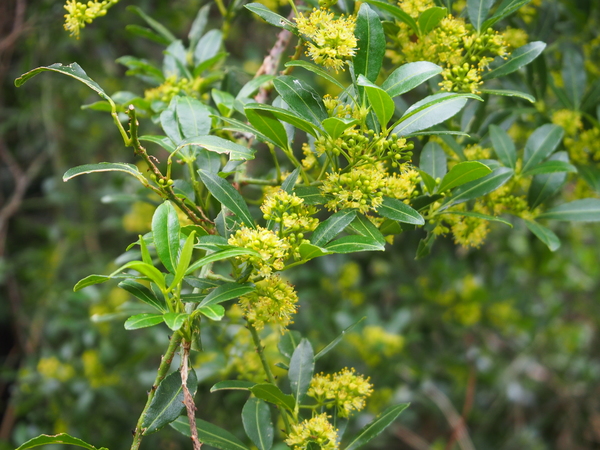
Japanese name: サルカケミカン Scientific name:Toddalia asiatica
[Overview]
An evergreen woody climber found in seaside forests.
The stems have sharp prickles 2 mm long that curve downward like hooks.
The leaves are alternate and trifoliate, 3–6 cm long.
The leaflets are oblong, 1.5–5 cm long and 0.7–1.5 cm wide, with a slightly notched tip.
The leaves are hairless on both sides, and the margin has low, fine serrations.
The petiole is 1–1.5 cm long.
Dioecious.
Panicles emerge from the leaf axils and branch tips; male inflorescences bear 3–4 flowers at each node, and female inflorescences bear 1 flower at each node.
Both male and female flowers are small, greenish white and 5-petaled.
The fruit is a spherical drupe 6–8 mm in diameter that ripens orange-yellow.
[Uses]
The fruit, leaves, stems and roots are used as folk medicine.
A yellow dye can be obtained from the roots.
[Notes]
In Okinawa, where it grows wild, it is called Sarakachi or Sarakacha, meaning "to snag a monkey."