
Plant Encyclopedia

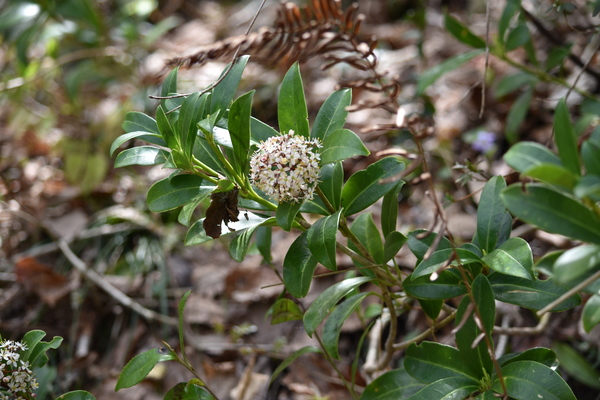
Skimmia japonica var. japonica (Japanese skimmia, "Miyamashikimi")
Japanese name: ミヤマシキミ (深山樒、深山梻)
Scientific name: Skimmia japonica var. japonica
[Overview]
An evergreen shrub 60–120 cm tall, found in forests at low elevations in the mountains.
The trunk is erect and branches freely.
Wart-like glandular dots are conspicuous on the young branches.
The leaves are alternate and simple, clustered in a whorl-like arrangement at the branch tips, oblanceolate-elliptic, 6–12 cm long and 2–3.5 cm wide.
The upper surface of the leaves is glossy, and the underside has oil dots.
The leaf margin is nearly entire.
The petiole is 0.5–1 cm long.
Dioecious.
Both male and female flowers are borne in large numbers in corymbose panicles 2–5 cm long at the branch tips, and are white and 4-petaled.
The fruit is a spherical drupe 8–10 mm in diameter that ripens red.
[Uses]
It is a poisonous plant, and a decoction of the leaves was used as a vermifuge and an insecticide.
It was formerly used as a folk medicine.
[Cultivation]
Propagate by cuttings.
It may die if exposed to frost or cold wind, so in cold regions grow it in a pot and bring it indoors to a sunny spot in winter.
In warm areas west of the Kanto region, it can overwinter outdoors.
It prefers a well-drained place that does not dry out.
It grows in sun to partial shade and is easily weakened by midsummer heat and direct sunlight, so for plants in the ground, it is best to plant them where they will be shaded in summer, such as under a tree.
Move potted plants to airy partial shade in summer.
For potted plants, water thoroughly when the soil surface dries; for plants in the ground, rainfall is sufficient unless sunny weather continues and the soil becomes severely dry.
In spring to autumn, apply a small amount of slow-release fertilizer.
Details
Japanese: ミヤマシキミ(深山樒、深山梻)、ハナシキミ(花樒、花梻)
Translated from our Japanese encyclopedia. If anything differs, the Japanese page is correct.