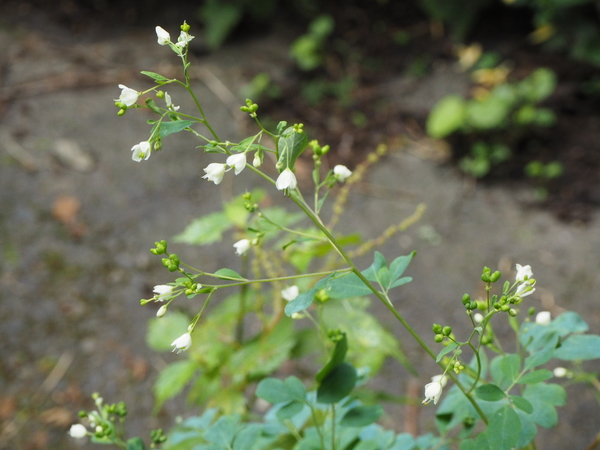
Boenninghausenia albiflora var. japonica("Matsukazeso")
Japanese name: マツカゼソウ(松風草) Scientific name:Boenninghausenia albiflora var. japonica
[Overview]
A perennial found in woods and at woodland edges in hills and mountains.
It is often seen in slightly moist places.
The whole plant has a distinctive smell.
The rhizome extends a short distance and spreads in clumps.
The stem is cylindrical, 50–80 cm tall, branching in the upper part and becoming somewhat woody.
The leaves are alternate and 3 times ternately pinnately compound, and the leaflets vary in size.
The leaflets are obovate to elliptic, with a whitish underside, and in young leaves the base is yellow.
Holding a leaflet up to the light reveals tiny black dots and transparent oil dots.
A conical cyme appears at the stem tip and bears sparse flowers.
The flowers are white and four-petaled, and the petals are oblong, 3–4 mm long.
There are 6–8 stamens, longer than the petals.
The fruit is an ovoid mericarp 3 mm long.
The seeds are kidney-shaped, 1.5 mm long.
[Uses]
The whole plant is used as an external medicine for muscle fatigue and neuralgia.