
Plant Encyclopedia

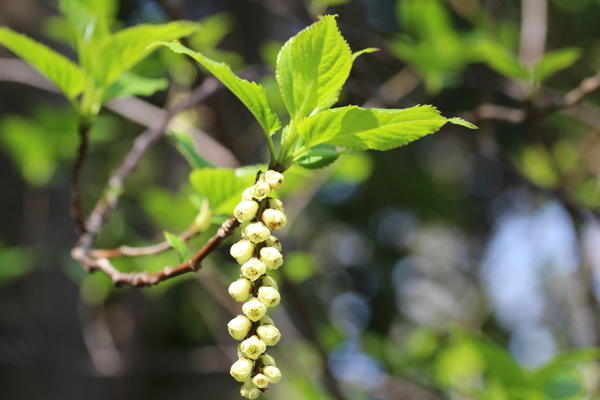
Stachyurus praecox var. praecox ("Kibushi")
Japanese name: キブシ (木五倍子、木付子)
Scientific name: Stachyurus praecox var. praecox
[Overview]
A deciduous shrub 3–7 m tall, growing on mountain and field slopes and in mixed woodland.
It tends to prefer sites along valleys.
The bark is somewhat glossy.
It branches freely from the base in a clumping form.
Leaves are simple and alternate, elliptic to ovate, 4–15 cm long and 2–7 cm wide.
The undersides of the leaves are whitish, with soft hairs on the veins.
The leaf margins are serrated.
The petiole is 1–3 cm long.
Dioecious or monoecious.
The flowers bloom before the leaves emerge.
Both male and female flowers are borne in large numbers on drooping racemes 3–7 cm long, arising from the leaf axils of the previous year's branches.
The inflorescences of bisexual and female flowers are shorter than those of male flowers.
The flowers are pale yellow, bell-shaped and 4-petaled, 7–9 mm long.
Each flower has 4 petal-like sepals and 4 purplish brown bracts.
The fruit is broadly elliptic to spherical, 7–12 mm across, and turns yellowish brown when ripe.
[Uses]
The young branches, leaves and fruit are used medicinally.
The fruit was used as a dye, as a substitute for gobaishi.
[Cultivation]
Propagate by cuttings.
Seed propagation is also possible, but since both male and female plants result, cuttings are usually taken from male plants, whose long inflorescences look more attractive.
It grows well in any soil as long as the site is sunny and well drained.
For potted plants, water thoroughly when the soil surface dries; for plants in the ground, rainfall is sufficient unless sunny weather continues and the soil becomes severely dry.
[Notes]
The Japanese name derives from the fact that it was a tree used as a substitute for gobaishi.
Details
Translated from our Japanese encyclopedia. If anything differs, the Japanese page is correct.