
Plant Encyclopedia

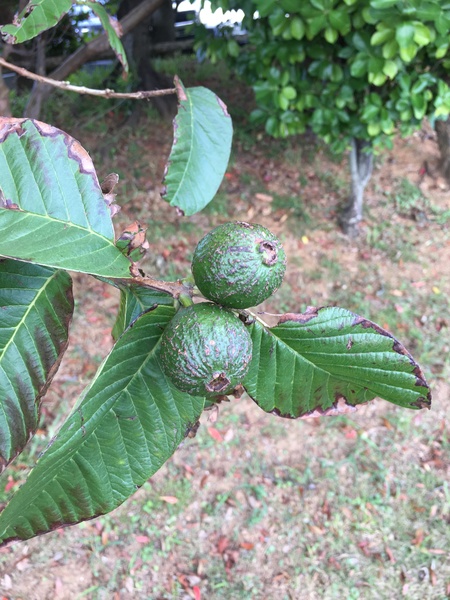
Psidium guajava (common guava, "Banjiro")
Japanese name: バンジロウ
Scientific name: Psidium guajava
[Overview]
An evergreen small tree 4–9 m tall.
The trunk branches near the ground, and the old bark peels off easily.
Young branches have 4 ridges.
Leaves are simple and opposite, oblong to ovate, 5–15 cm long and 4–7 cm wide, with a markedly sunken, conspicuous midrib and pinnate lateral veins, and densely hairy undersides.
The leaf margin is entire.
It flowers year-round if conditions such as temperature are suitable.
The flowers are borne 2–3 at a time in the leaf axils; they are white with 4–5 petals, about 2.5 cm across, and the many long stamens are conspicuous.
The flowers are fragrant.
The fruit is usually spherical or elliptic to pear-shaped, 5–12 cm long and 3–7 cm across, but the size varies with the cultivar, and the weight also ranges widely from 30 to 400 g.
The skin is green at first and turns yellow to yellowish green when ripe; the surface is smooth, but it is indistinctly 5–10-angled or has 5–10 shallow grooves, giving it the look of a young pomegranate.
The flesh is mostly white, but may be yellow or red.
The flesh contains stone cells like those seen in pears, so it has a gritty texture.
[Uses]
The ripe fruit has a distinctive fragrance and is eaten raw or made into juice and jam.
The bark is used medicinally, and the leaves are used as a substitute for tea.
It is also used to rear lac insects, from which a red dye is obtained.
[Cultivation]
Propagate by cuttings.
It prefers sunny, well-drained, calcareous sandy soil, but its tolerance of soil acidity is wide, pH 4.5–8.2, so it is not particular about soil.
It is desirable to keep the winter minimum temperature at 5°C or above.
From spring to autumn, water thoroughly when the soil surface dries; in winter, keep it on the dry side.
From spring to autumn, apply a fertilizer with equal amounts of the three components or one relatively high in phosphate.
Prune after harvesting the fruit, but flower buds form on the terminal and axillary buds of the previous year's branches, so do not cut the branch tips back hard.
Pests include aphids and scale insects.
[Notes]
The names Banjiro and Banzakuro (蕃石榴) come from the resemblance of the fruit shape and bark to those of the pomegranate (zakuro).
Details
Japanese: バンジロウ、グァバ、バンザクロ(蕃石榴)、オオミバンジロウ
Translated from our Japanese encyclopedia. If anything differs, the Japanese page is correct.