
Plant Encyclopedia

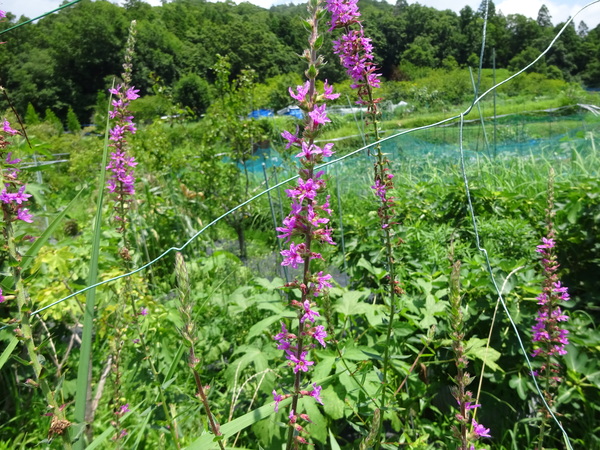
Lythrum salicaria (purple loosestrife, "Ezomisohagi")
Japanese name: エゾミソハギ (蝦夷禊萩)
Scientific name: Lythrum salicaria
[Overview]
A perennial about 0.5–1.5 m tall, found in wetlands.
It is usually densely covered with short hairs (papillate projections) throughout, but the amount of hair varies, and some plants are almost hairless.
The stem has 4 or 6 ridges.
The leaves are simple, cross-opposite or in whorls of 3, lanceolate, 3.5–6.5 cm long and 0.8–1.5 cm wide, with the base slightly clasping the stem.
A spike 20–35 cm long at the stem tip bears many reddish-purple, 6-petaled flowers about 1.5 cm across.
Needle-like appendages between the calyx lobes are erect.
There are 12 stamens, of differing lengths.
The style comes in 3 types: long, medium and short.
The calyx tube has 12 ridges.
The fruit is a capsule.
The very similar Misohagi is hairless throughout, its leaf bases do not clasp the stem, and the appendages between the calyx lobes spread outward.
[Uses]
The whole plant is used medicinally.
[Cultivation]
Propagate from seed, by cuttings, or by division.
It prefers a sunny, constantly moist site and is well suited to being planted in paddy soil.
Take care that it does not dry out; for potted plants it is best to water by standing the pot in shallow water, and for plants in the ground, water when the soil surface dries.
When planting in shallow water such as a pond, set the water depth at about 3–7 cm.
Fertilize sparingly; if base fertilizer is applied, nothing more is particularly needed, but for potted plants bury a small amount of slow-release fertilizer in the soil in spring.
There are no particular pests or diseases.
Details
Japanese: エゾミソハギ(蝦夷禊萩)
Translated from our Japanese encyclopedia. If anything differs, the Japanese page is correct.