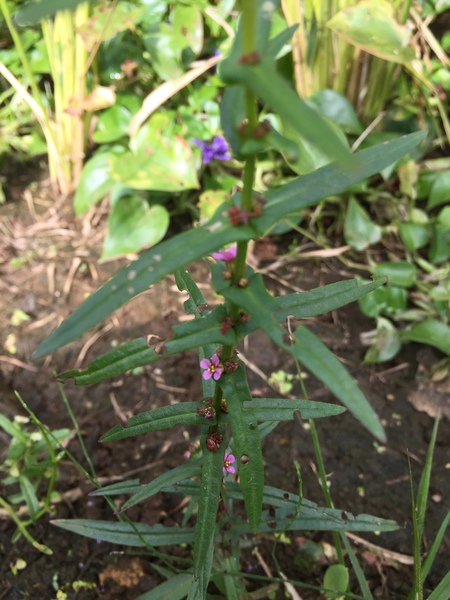
Japanese name: ホソバヒメミソハギ(細葉姫禊萩) Scientific name:Ammannia coccinea
[Overview]
An annual 20–100 cm tall, found in rice paddies, fallow paddies, marshes and the like, often growing in colonies.
The whole plant is hairless.
The stem has 4 ridges, is erect, and branches well.
The leaves are simple and decussate (opposite), narrowly lanceolate to linear, 2–8 cm long, with the base distinctly ear-shaped and clasping the stem.
The flowers are reddish purple, 4-petaled, about 4 mm across, and borne in clusters of 2–5 in the leaf axils.
Yellow anthers project from the flowers.
The calyx is tubular with 4 ridges at flowering time and encloses the fruit at the fruiting stage.
The fruit is a spherical capsule, glossy and reddish brown; at first it is enclosed by the calyx, but later only the top is exposed.
[History]
It was collected in Sasebo in 1952, and it is now naturalized from the southern Kanto region southward to the Ryukyu Islands, where it is a weed of rice paddies.